
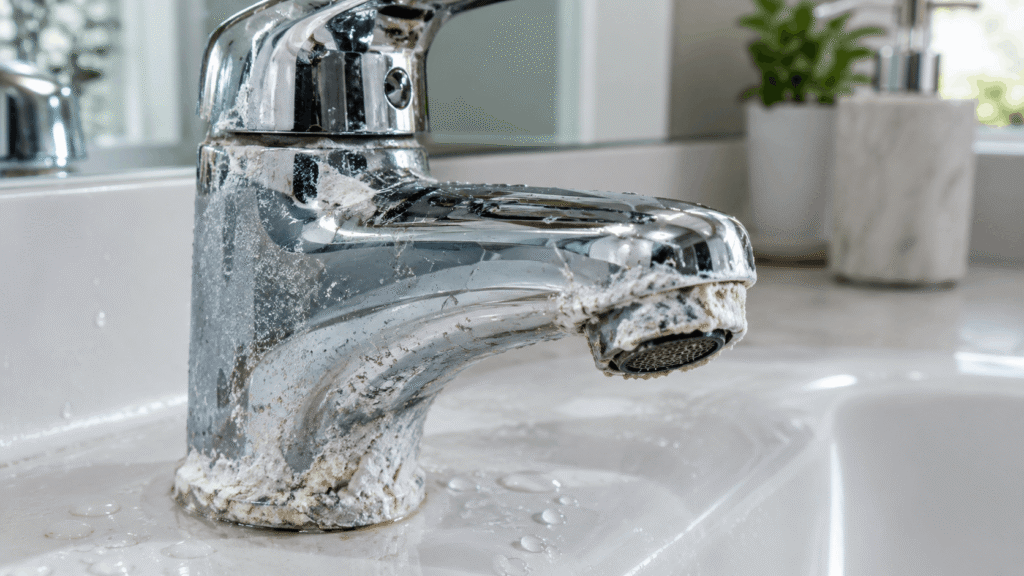
White crust around faucets and showerheads is usually mineral scale – calcium and magnesium left behind after hard water dries on a surface. El Paso Water describes the local supply as moderately hard to hard, which makes this common citywide. But not every white mark is scale: soap residue, cleaner film, corrosion, or finish damage can all look similar, so identifying the buildup correctly matters before you reach for a cleaner.
Key points to know first:
- White, chalky buildup usually points to mineral deposits – calcium and magnesium are the main hardness minerals
- Faucet aerators and showerhead nozzles collect scale around their small openings first
- Not every white deposit is caused by hard water
- Cleaning methods should match the fixture’s actual finish
- If flow, spray, or dripping problems remain after cleaning, another fixture issue may be present
What Causes White Crust on Fixtures?
Hard water carries dissolved calcium and magnesium that move through your plumbing invisibly – they’re not usually visible while still dissolved. The white or chalky look starts once water evaporates and leaves those minerals behind on the surface. Faucets and showerheads go through repeated wet-and-dry cycles every day: water lands on a tip, base, aerator, or nozzle, then slowly evaporates, leaving a thin mineral layer behind. Each new cycle adds another layer, and over time those layers become visible as scale or limescale.
Why This Is So Common in El Paso
El Paso Water’s own FAQ describes the local supply as moderately hard to hard – meaning there’s enough calcium and magnesium in the water for this kind of deposit to be a realistic, citywide issue around fixtures. How much you actually see varies by fixture: one that stays wet, drips slowly, or gets heavy daily use will show buildup faster than another fixture in the same house. Visible crust suggests a hard-water problem, but it doesn’t tell you the exact hardness level – a proper water hardness test is the better way to measure that if you want a real number.
Is Every White Deposit Actually Hard-Water Scale?
White marks get blamed on hard water by default, but appearance alone isn’t enough to confirm the cause.
| Appearance | Possible Cause | What to Notice |
| White, dry, chalky crust | Mineral scale | Often appears where water repeatedly dries |
| Soft or cloudy film | Soap or cleaner residue | Usually wipes away more easily |
| Green or blue material | Possible corrosion | Look for metal discoloration or pitting |
| Orange or rust-colored material | Iron or corrosion-related deposit | Usually looks different from white scale |
| Peeling or dull surface | Fixture finish damage | May not be removable buildup at all |
Mineral scale tends to look dry, hard, and chalky. Soap film feels softer or slicker. Corrosion often comes with color changes, rough metal, or pitting. If the surface itself looks damaged rather than coated, stronger descaling won’t fix it – that’s a finish problem, not a removable deposit, and it’s worth having checked rather than scrubbing harder.
Where Mineral Scale Actually Builds Up
Faucet aerators – the small openings and screens at the faucet’s end collect deposits and debris first. As buildup gets heavier, partial blockage can change the stream’s shape or reduce flow at that one fixture.
Faucet base and spout – water collecting around the base, handles, and spout after normal use can leave a visible ring or chalky layer once it evaporates; the tip itself often develops crust where droplets repeatedly form and dry.
Showerhead nozzles – another common spot, where deposits narrow individual openings and change the spray pattern. Some jets spray sideways, weaken, or stop flowing evenly – that doesn’t prove every shower flow problem traces to hard water, but visible scale around the nozzles is a reasonable place to start checking.
How to Remove White Mineral Buildup Safely
- Check the finish first. Chrome, brushed nickel, matte finishes, and coated surfaces don’t all tolerate the same products – a cleaner strong enough to dissolve scale can also damage plating or discolor a finish if it’s too aggressive or left on too long. Check the manufacturer’s care instructions before anything else.
- Start gentle. A soft cloth with an approved mild cleaner often handles light surface deposits without scratching the finish. Skip abrasive pads, metal tools, or hard scraping – those can leave permanent marks even after the scale is gone.
- Use vinegar carefully, not automatically. Diluted white vinegar dissolves some hard-water deposits, but it isn’t safe for every finish. Follow the manufacturer’s guidance on concentration and contact time, and rinse thoroughly afterward.
- Clean small parts separately. Removable aerators or showerhead components can hold heavier scale in their small openings – if the fixture is designed for homeowner maintenance, clean those pieces per the manufacturer’s directions. Don’t force a seized part loose; a cracked fitting or broken finish turns a cleaning job into an actual repair.
Why Does the Crust Keep Coming Back?
Cleaning removes what’s already on the fixture – it doesn’t remove calcium and magnesium from the water still coming through. If hard water keeps wetting the same surface, new residue forms as it dries, which is exactly why a faucet can look clean right after descaling and grow another ring weeks later. A slow drip makes this worse by repeatedly wetting the same spot. If scale is recurring across several fixtures at once, that’s a reason to check your home’s actual water hardness rather than keep judging it by one faucet’s appearance.
When Cleaning Is Enough – and When It Isn’t
Cleaning was probably enough if: normal flow returns, shower spray is even again, there’s no active dripping, the aerator or nozzles are clear, and the fixture’s finish is still intact.
Something else needs attention if: flow stays weak after the aerator is clean, spray is still uneven, the fixture keeps dripping, a removable part is seized or damaged, the finish is pitted or permanently discolored, or heavy crust keeps reforming around one specific leaking point. At that stage, stop reaching for stronger cleaners and have the fixture inspected instead – repeated scrubbing won’t fix a worn cartridge or a hidden drip.
Slowing Down Future Buildup
Wiping wet faucet surfaces after use when it’s practical, keeping aerators and nozzles clean before heavy scale sets in, and repairing persistent drips (which keep the same spot wet) all help – though none of it changes the hardness of the water itself. Use only cleaners approved for your specific fixture finish. If similar buildup is showing up throughout the house, a real water hardness test tells you more than judging it by one faucet.
Frequently Asked Questions
1. Why does white crust build up faster around one faucet than another? Different fixtures stay wet for different lengths of time – a slow drip, splash pattern, faucet design, or heavier daily use can leave more water sitting on one surface, speeding up visible buildup there.
2. Why does my showerhead still spray unevenly after I clean off the white buildup? If visible scale is gone but the spray pattern is still off, deposits may remain inside the nozzles themselves, or another showerhead or valve issue is present – cleaning the outside alone doesn’t always restore normal flow.
3. Can white mineral buildup hide a small faucet leak? It can make the area harder to inspect – heavy crust around a spout, base, or handle can cover the exact point where water is escaping. After cleaning, check whether fresh moisture or dripping returns in that same spot; if it does, that’s worth having checked rather than cleaned again.
4. Should I replace a faucet aerator if the scale won’t come off? Often, yes – if it stays blocked, damaged, or heavily scaled after safe cleaning, replacing the small, inexpensive part usually makes more sense than repeatedly using stronger cleaners that risk the fixture’s finish.
5. Why does buildup keep forming around the base instead of the spout? Water may be collecting there from splashing, wet hands, or a small leak near the handle or fixture connection – repeated wetting and drying in that one area can leave deposits even when the faucet tip looks clean.
Get a Persistent Fixture Problem Checked
If cleaning doesn’t bring flow, spray, or dripping back to normal, the issue is probably more than surface scale. Paso Plumbing (TX License #12051) can inspect the fixture and its supply path to find what’s actually behind it – call (915) 200-8525 or request an estimate.
Sources: El Paso Water – Frequently Asked Questions (water hardness classification, epwater.org); Paso Plumbing company information as published on pasoplumbing.com.