
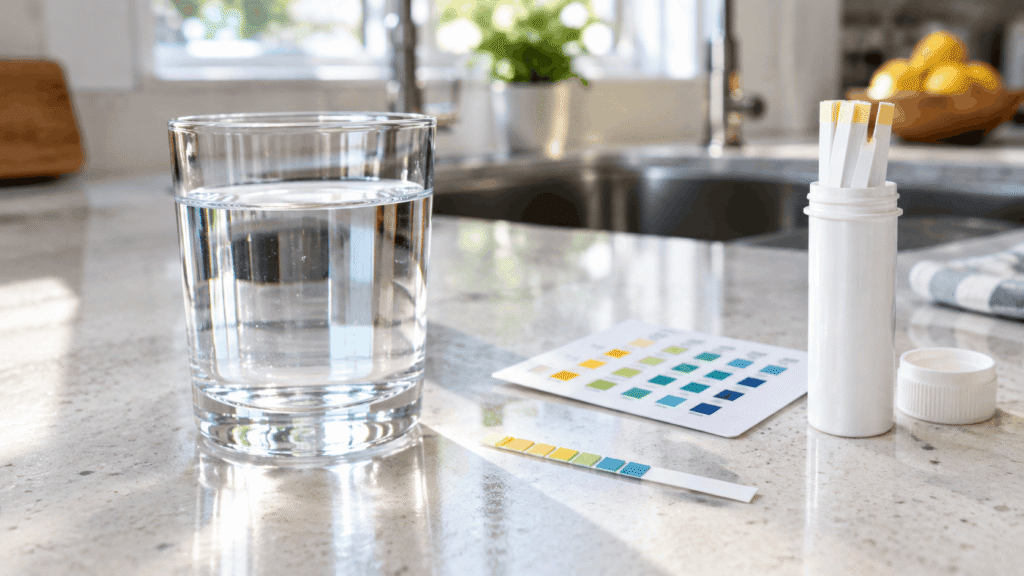
To test water hardness at home, use hardness test strips for a quick range or a drop-count kit for a precise number – not a TDS meter, which can’t measure hardness. Sample cold, untreated water. El Paso Water’s published average is about 175 mg/L (10.2 grains per gallon), but only a test at your tap shows what reaches your home.
El Paso Water describes the local supply as moderately hard to hard because of its calcium and magnesium content. That city-level description is useful context, but it can’t tell you the hardness at one faucet in your house. Below is which method fits which decision, how to sample correctly, and how to read the number you get.
Key points before testing:
- Mineral residue and poor soap lather are clues, not measurements
- Test strips give a range; drop-count kits give a more specific number
- A TDS meter is not a hardness test
- Sample location matters – test untreated water to learn what enters your home
- Use the result to confirm the problem before choosing equipment
What Does a Water Hardness Test Measure?
Hardness is mainly dissolved calcium and magnesium. The U.S. Geological Survey defines it exactly that way and reports it as milligrams per liter (mg/L) “as calcium carbonate” (CaCO₃) – a standard basis that lets calcium- and magnesium-related hardness be compared on one scale. You’ll also see results in parts per million (ppm) or grains per gallon (GPG); the units are easy to convert once you have a number (see the conversion table below).
White spots, crusty fixtures, or weak lather make hard water worth checking, but they can’t tell you whether the water measures 5, 10, or 15 GPG. Use household signs as a reason to test, and a hardness-specific test to find the level. USGS also cautions that its national hardness data isn’t meant for decisions at the scale of an individual home – local detail should come from your utility, or from a direct test of your own water.
Which Water Hardness Test Should You Use?
| Method | What It Tells You | Precision | Best Use | Main Limitation |
| El Paso Water data | General local hardness | Broad baseline | Understanding local conditions | Not a reading from your faucet |
| Soap test | Whether hardness may be present | Low | Quick first check | No hardness number |
| Test strips | Approximate hardness range | Moderate | Routine home testing | Depends on color bands |
| Drop-count kit | More specific hardness reading | Higher | Treatment decisions, softener checks | More careful steps |
| Laboratory test | Measured lab result | High | Broader or more detailed analysis | More time and cost |
Utility data. El Paso Water’s published chemical analysis says hardness averages about 175 mg/L, or about 10.2 grains per gallon. That sits in the USGS “hard” band (121–180 mg/L), close to its upper edge. The same report lists source-by-source values from 63 to 236 mg/L, which shows why one citywide figure can’t stand in for your tap – the top of that range would be “very hard” on the USGS scale.
Soap test. Shake a bottle one-third full of tap water with a few drops of pure liquid soap. USGS explains that soap reacts with calcium to form soap scum, so weak lather suggests hardness – but it’s a clue, not a number.
Test strips. The strip changes color and you compare it with the kit’s chart. The result is a range, which is usually enough to tell whether water is soft, moderately hard, or hard.
Drop-count kit. Reagent drops are added to a measured sample until the color changes; the drop count converts to a hardness value. It’s a simplified version of the titration approach laboratories use for hardness analysis.
Laboratory test. Worth it when you need broader water-quality information. El Paso Water runs an accredited International Water Quality Lab for its own supply (915-594-5733 for questions about utility water quality), but that isn’t an analysis of a sample from your home. For a private sample, look for a lab accredited under the Texas Commission on Environmental Quality’s NELAP program.
Where Should You Take the Water Sample?
The sample point should match the question. A valid reading from the wrong side of a softener answers the wrong question.
- Use cold water. For an incoming-supply check, skip the hot tap – hot water has already passed through your water heater.
- Test untreated water. To learn what enters the property, sample before any softener. To check a softener, compare an untreated sample with a treated one. Rheem’s softener guidance says to confirm the faucet you test is actually fed by the softener when checking treated water.
- Run the tap briefly first, so you aren’t sampling water that has been sitting in the fixture, then use the exact sample volume your kit specifies.
- Use the same faucet every time if you plan to compare readings over time.
Should I test an outdoor faucet for water hardness? Only if you’ve confirmed it receives untreated incoming water. Many outdoor taps bypass a softener, but don’t assume it – trace the plumbing path first.
How can I tell whether my test is measuring softened or untreated water? Trace the sample point relative to the softener, or check which fixtures are known to bypass it. If that’s unclear, comparing a likely-untreated tap with a known-treated one gives a clue, but the plumbing layout should confirm it.
Can I use reverse-osmosis water to measure my home’s incoming hardness? No. Water from a point-of-use RO system has already been treated, so it doesn’t represent the supply entering your property. Test upstream of treatment equipment.
How to Use Water Hardness Test Strips
Strips are the simplest way to test water hardness at home, but each brand sets its own dip time, reading window, and units – Rheem’s strips, for example, call for a 3-second dip, and another brand may differ.
- Read the instructions first – note dip time, reading window, and the unit on the chart. Check the expiration date.
- Collect fresh cold water from your chosen sample point.
- Dip the strip as directed, without touching the test pad.
- Match the color to the chart within the stated window – colors can keep changing afterward.
- Record the number and the unit (GPG, ppm, or mg/L), not just the color.
What if the strip color falls between two hardness levels? Repeat with a fresh strip and watch the reading time. If it still sits between bands and you need a specific number for equipment settings, use a finer method such as a drop-count kit.
Why do two brands of strips give different results? Ranges, color scales, reagents, and units differ. Confirm both results use the same unit and were read per their own instructions before comparing numbers.
When a Drop Test Gives a Better Answer
Strips are fine when a range is enough. A drop-count test earns its extra effort when the difference within a range matters – confirming a borderline strip result, comparing readings over time, setting a softener, or establishing incoming hardness before a treatment decision. It’s also the cleaner way to check a softener: take one untreated and one treated sample, same method and units, and compare. Rheem’s rinse-water check treats 0–3 GPG (0–50 ppm) as soft water for its own softeners.
How to Read Your Water Hardness Result
Once you test water hardness at home, the number only helps if you know its unit. One grain per gallon equals 17.1 mg/L (stated in El Paso Water’s own chemical analysis), and for water measurements ppm is commonly treated as equal to mg/L.
| Class (USGS) | mg/L as CaCO₃ (≈ ppm) | Grains per gallon* |
| Soft | 0–60 | 0–3.5 |
| Moderately hard | 61–120 | 3.6–7.0 |
| Hard | 121–180 | 7.1–10.5 |
| Very hard | Over 180 | Over 10.5 |
*GPG converted from USGS’s mg/L bands using 1 GPG = 17.1 mg/L.
Worked example: El Paso Water’s 175 mg/L average ÷ 17.1 ≈ 10.2 GPG – “hard,” near the very-hard line.
Why does my lab report use mg/L while my softener uses GPG? Labs and utilities usually report mg/L as CaCO₃; residential softeners usually use GPG. Divide mg/L by 17.1 to get GPG.
“Hardness as CaCO₃” doesn’t mean the test found only calcium carbonate – it’s a standard way to express the combined hardness from calcium, magnesium, and other hardness-producing ions. These classes describe water; they don’t automatically tell you to buy a treatment system.
Why a TDS Meter Cannot Measure Hardness
A TDS meter estimates total dissolved solids from electrical conductivity, so it counts everything dissolved – not just calcium and magnesium. Rheem is blunt about it: a TDS meter is not a valid test for hardness, and it won’t show how well a softener is working, because a softener exchanges hardness minerals for sodium or potassium instead of removing dissolved solids. Raw and softened water can read almost the same on a TDS meter while a proper hardness test shows a big difference.
El Paso’s own numbers show why they’re different measurements: the utility’s chemical analysis lists total dissolved solids of 454–862 mg/L by source, against total hardness of 63–236 mg/L.
Why Your Home Test May Differ From El Paso Data
The utility figure is system-level context, drawn from multiple sources including the Hueco Bolson aquifer. A home test measures one location at one moment – and treatment changes it further.
Why do two faucets in my house show different hardness? First check whether both receive water through the same treatment path. Some kitchen, outdoor, or other lines bypass a softener. Use the same method at both before blaming the municipal supply.
Can hardness change without any plumbing work at my house? Yes – a utility that blends sources can deliver different hardness over time. Repeat the test to confirm a change is real before assuming your plumbing caused it.
Softener or Filter?
A hardness result tells you whether calcium and magnesium are part of the problem – not that every water concern needs the same fix. If testing confirms hard water, a softener is the category designed to reduce those minerals. A standard filter targets other things (sediment, taste, odor, chlorine, specific substances) and isn’t automatically a substitute. If you have hard water and another concern, identify each separately before choosing equipment, and don’t buy a system because of spots or residue alone. El Paso Water’s own FAQ says it does not recommend water softeners for drinking water, so treatment should match the actual condition of your water and plumbing.
What Should You Do With Your Test Result?
- Clear result: record the number and unit and use that value when comparing treatment options – not just white residue.
- Uncertain result: repeat with the same sample point and method.
- Existing softener: compare untreated and softened water using the same hardness test, never a TDS reading.
- Hard or very hard result: scale becomes a realistic concern for your water heater, your faucets and showerheads, and older supply piping.
When should I retest after my softener regenerates? Let it return to normal service and follow the manufacturer’s instructions, then use a hardness-specific test at a known treated fixture and compare with untreated water.
Does a normal hardness result mean my water has no other quality problems? No. Hardness testing answers a narrow question about calcium and magnesium. It doesn’t rule out sediment, disinfectant levels, metals, microorganisms, or other issues that need their own tests.
Know What Your Water Actually Needs
If you test water hardness at home and the result is hard or very hard – or you see scale on fixtures, a struggling water heater, or restricted flow – Paso Plumbing (TX License #12051) can inspect the affected plumbing and tell you whether buildup, wear, or another plumbing issue is the real cause. Call (915) 200-8525 or request an estimate.
Sources: U.S. Geological Survey, Water Science School – “Hardness of Water” (usgs.gov); El Paso Water – Chemical Analysis report, Water Quality page, and FAQ (epwater.org); Rheem Water Treatment support articles (rheemwatertreatment.zendesk.com); Texas Commission on Environmental Quality – Laboratory Accreditation (tceq.texas.gov); Paso Plumbing company information as published on pasoplumbing.com.