
Quick answer: El Paso Water requires every backflow prevention assembly to be tested when it is installed and at least once a year after that. The test must be done by a TCEQ-licensed tester, and the original report goes to El Paso Water. Most tests take under an hour. If a device fails, it has to be repaired and tested again.
If you own or manage a restaurant, clinic, shop, school or apartment complex in El Paso, you probably have at least one backflow assembly on your property. Many owners only learn about it when a letter or a tester shows up. This guide covers backflow testing in El Paso: what the yearly test is, who is allowed to do it, what it usually costs, and what to do when a device fails, so the next notice does not catch you off guard.
What a Backflow Test Checks
A backflow assembly is a set of valves that lets water flow into your building but never back out into the city main. Our guide on what a backflow preventer is covers the basics. The yearly test confirms those valves still seal the way they should.
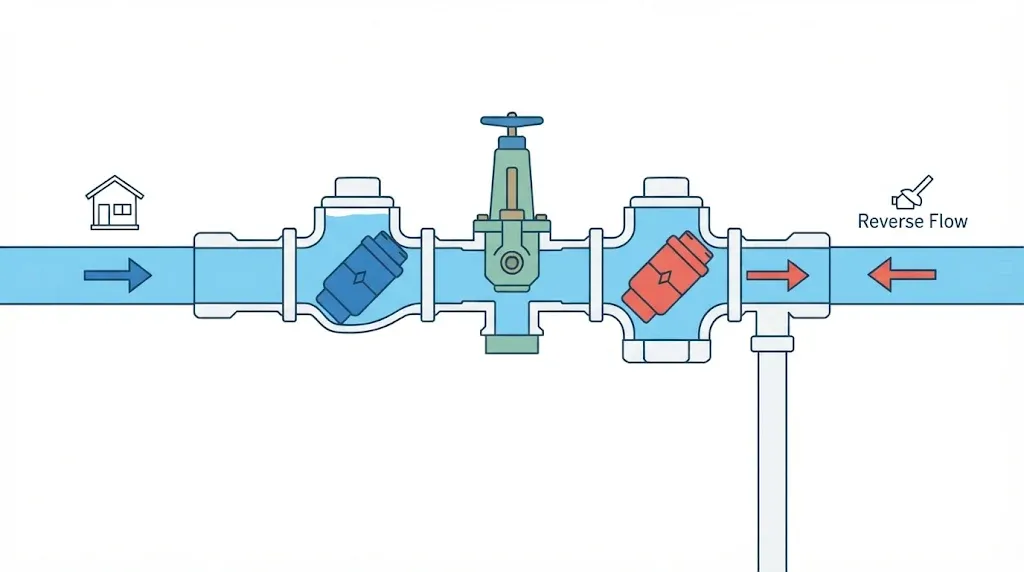
Backflow can happen two ways. Back-pressure happens when pressure inside your building gets higher than the city supply, for example from a boiler, a pump or a fire sprinkler system. Back-siphonage happens when city pressure drops, such as during a water main break or heavy firefighting nearby, and the drop pulls water backward out of your pipes. Either way, water that has touched chemicals, soap, grease or stagnant sprinkler lines could reach the drinking water supply.
During the test, the tester connects a calibrated differential pressure gauge to the small test cocks on the assembly. They close the shut-off valves in a set order and read whether each check valve holds pressure. On a reduced pressure (RPZ) assembly, they also confirm the relief valve opens at the right point. The numbers go on the test report.
What Are El Paso’s Backflow Testing Requirements?
El Paso Water inspects assemblies at installation, then requires a test at least once a year by a TCEQ-licensed tester. The original report goes to El Paso Water.
These rules come from El Paso Water’s cross-connection control program, written in its Rules and Regulations, Section V, Protection of Water Supply. The state rules behind them are set by the Texas Commission on Environmental Quality (TCEQ).
A few details from El Paso Water’s program that business owners often miss:
- New services: an assembly on a new water service has to be tested right after installation and before water service starts.
- After repairs or moves: an assembly must be tested again any time it is repaired or relocated, not only once a year.
- Approved devices only: containment assemblies must be approved by the University of Southern California Foundation for Cross-Connection Control and Hydraulic Research. The approval should be listed in the device manual.
- Licensed installation: a licensed plumber has to install the assembly.
For questions about whether a specific device is approved or about testing rules, El Paso Water’s cross-connection line is (915) 594-5782.
Which Businesses Need a Backflow Assembly?
Any property where water could be contaminated and pulled back into the city supply needs protection. In El Paso, that usually includes these kinds of businesses and buildings:
- Restaurants, taquerias, bakeries and coffee shops (dish machines, soda systems, chemical dispensers)
- Medical, dental and veterinary offices
- Car washes, laundromats and salons
- Schools, churches and gyms with boilers or pools
- Apartment complexes and offices with fire sprinkler systems
- Any property with an irrigation system or a hose bib used with chemicals
Restaurants have more cross-connections than most businesses. Our restaurant plumbing maintenance checklist shows where the yearly test fits in with grease trap pumping, jetting and water heater service.
Types of Backflow Devices and How Each Is Tested
El Paso Water accepts five kinds of protection. The right one depends on the hazard and how it is installed.
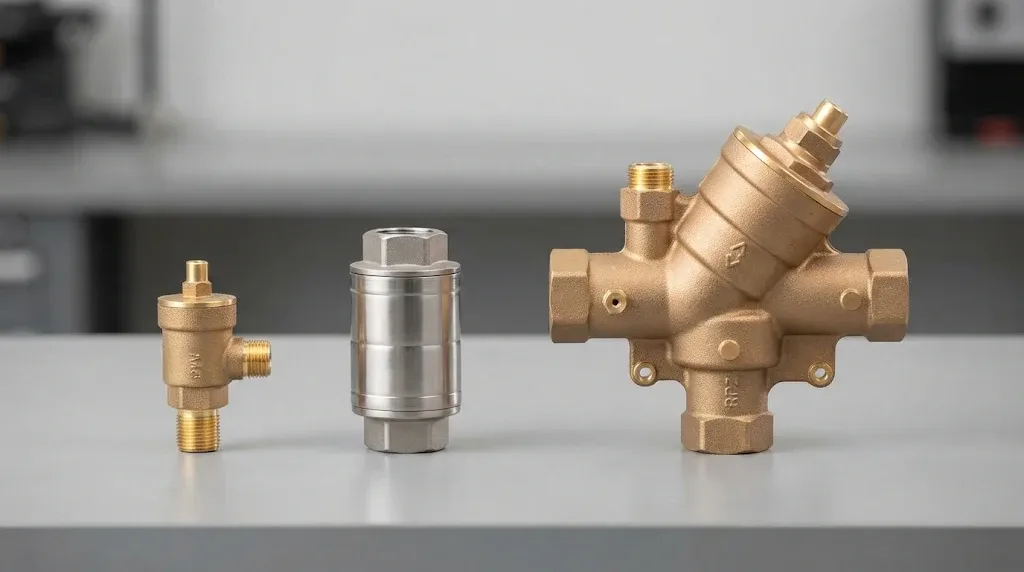
- Air gap. An open space between the water outlet and anything that could hold dirty water. It has no moving parts, so it is the most reliable option. It is inspected, not tested with a gauge.
- Reduced pressure principle assembly (RPZ). Two check valves with a relief valve between them. Used for high hazards like chemicals, boilers and medical equipment. The tester checks both valves and the relief valve opening point.
- Reduced pressure detector assembly. An RPZ with a small meter bypass, common on fire sprinkler lines.
- Double check assembly (DCVA). Two check valves without a relief valve. Used for lower hazards, including many fire sprinkler systems.
- Pressure vacuum breaker (PVB). Common on irrigation. The tester checks the check valve and the air inlet.
Who Can Test a Backflow Preventer in El Paso?
Only a backflow prevention assembly tester licensed by TCEQ can perform the annual test. A general plumber without that license cannot sign the report, and you cannot test it yourself.
Ask the tester for their TCEQ license number and the calibration date on their gauge before they start. A test done with an out-of-date gauge or by an unlicensed person can be rejected, and you would have to pay for it again.
Fire sprinkler lines can have extra rules. In Texas, testers who work on fire suppression assemblies may need to meet fire-protection licensing requirements, so confirm this with your sprinkler contractor if your building has a fire line.
How Much Does Backflow Testing Cost?
Most testers charge per assembly. In the Southwest, prices commonly run from about $100 to $350 per device, depending on size, location and how easy it is to reach.
A ¾ inch irrigation PVB sits at the low end. A 4 inch or 6 inch fire line assembly in a vault costs more.
Things that raise the price:
- Several assemblies on one property, each tested and reported separately
- Assemblies in vaults, mechanical rooms or on rooftops
- Large fire line assemblies that need extra coordination
- A failed test that needs parts, a rebuild and a retest
When you get a quote, ask if it includes filing the report with El Paso Water and whether a retest after repairs costs extra. Booking all your assemblies on one visit usually costs less than separate trips.
What Happens If a Backflow Test Fails?
The assembly must be repaired or replaced, then tested again by a licensed tester. A passing retest report is what closes the issue with El Paso Water.
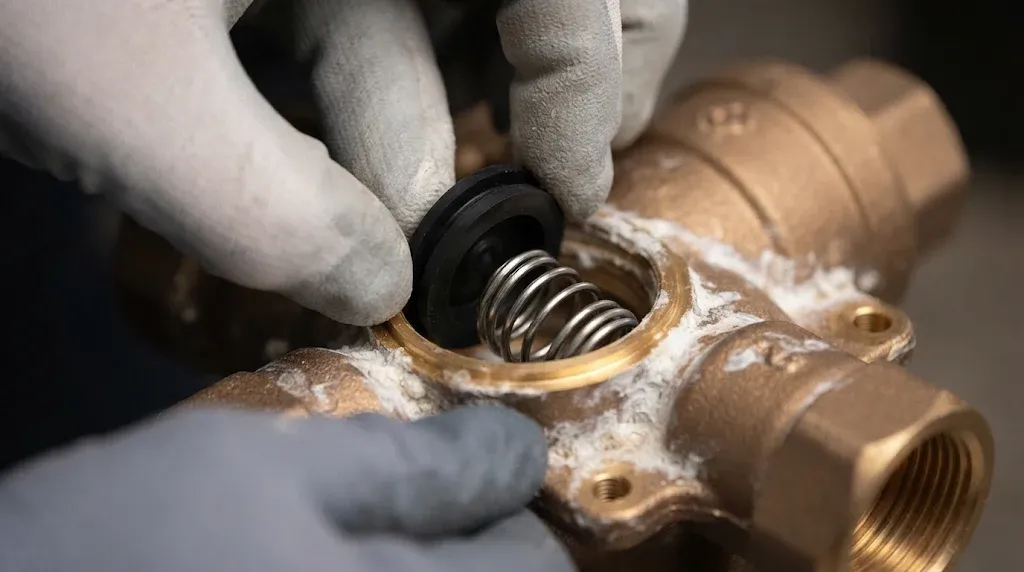
Most failures come from a few parts. A check valve does not seal because of debris or a worn rubber disc. A spring gets weak. On an RPZ, the relief valve sticks or drips. El Paso’s hard water makes this more common, because calcium scale builds up on seats and moving parts and keeps them from closing tight.
Many devices can be rebuilt with a parts kit on the same visit. If the body is cracked, the threads are damaged, or the model is old enough that parts are hard to find, replacing the assembly is usually the better choice. A replacement has to be an approved model and installed by a licensed plumber.
A dripping relief valve between tests is an early warning. Our article on water coming out of a backflow preventer explains what the dripping means and when to call.
How Often Should a Backflow Preventer Be Tested?
At least once a year in El Paso, plus right after installation, after any repair and after the assembly is moved. High-hazard sites may need more frequent checks.
Freeze Protection for Above-Ground Devices
El Paso does not freeze often, but a hard freeze cracks above-ground assemblies every few winters. El Paso Water recommends turning off the sprinkler controller, covering or insulating the device, closing the isolation valve and opening the bleeders before a freeze. If the device breaks, shut the water off at the meter. Repairs are the owner’s responsibility, and the assembly has to pass a test after the repair. Our guide on how to prevent frozen pipes in El Paso covers the rest of the property.
How to Stay on Schedule Without the Hassle
- Make a list of every assembly. Write down the location, size, type and serial number. Many owners find one they did not know they had.
- Pick one testing month. Testing everything at once makes it easier to track and often lowers the price.
- Keep every report. Save the test report, repair notes and any El Paso Water letters in one folder. Inspectors, insurers and buyers may ask for them.
- Fix drips right away. A leaking device is already failing, and the leak wastes water you pay for.
- Plan around your hours. The water is shut off for part of the test, so restaurants and clinics should book before opening or after closing.
Backflow Testing in El Paso for Businesses
Paso Plumbing handles commercial plumbing for restaurants, offices, retail and apartment properties across El Paso, Horizon City and Socorro. We install approved assemblies, rebuild and replace failed devices, and coordinate testing so your report gets to El Paso Water on time. Call (915) 200-8525 to set up your yearly test or get a failed device fixed.
Backflow Testing FAQs
Is backflow testing required by law in Texas?
Yes. TCEQ rules require testable backflow assemblies that protect against health hazards to be tested, and El Paso Water requires a yearly test by a TCEQ-licensed tester for every assembly.
Who sends the backflow test report to El Paso Water?
The tester fills out the test and maintenance report after the test. The original must reach El Paso Water, so confirm your tester files it and gives you a copy.
How long does a backflow test take?
A single assembly usually takes 20 to 45 minutes when it passes. Water to the building is shut off during part of the test, so plan around busy hours.
Can I test my own backflow preventer?
No. The test must be done by a TCEQ-licensed tester using a calibrated gauge. A visual check or a homemade test does not count as a valid annual test.
What is the difference between an RPZ and a double check valve?
An RPZ has two check valves and a relief valve that dumps water if both fail, for high hazards. A double check skips the relief valve and suits lower hazards.
Why is my backflow preventer leaking?
On an RPZ, water from the relief valve usually means a check valve is not sealing because of debris, scale or worn parts. Constant dripping needs repair soon.
Do fire sprinkler systems need backflow testing?
Yes. Most fire sprinkler lines have a double check or RPZ assembly that needs a yearly test. Fire lines may also need a tester who meets fire-protection licensing rules.
Does a home irrigation system need a backflow test in El Paso?
Irrigation systems use backflow devices, and testable assemblies fall under the yearly testing rule. Check with El Paso Water about your specific device, since requirements depend on type and installation.
Can a failed backflow preventer be repaired?
Often, yes. Many assemblies pass again after cleaning or a rebuild kit replaces discs, springs and seals. Cracked bodies, damaged threads or discontinued models usually need a full replacement instead.
What happens if I skip my annual backflow test?
El Paso Water tracks yearly reports for each assembly. A missing report can lead to notices and enforcement, and an untested device may not protect your water.
The Bottom Line
Backflow testing in El Paso is required for every assembly at installation, after repairs or moves, and at least once a year by a TCEQ-licensed tester. The original report goes to El Paso Water. Expect to pay roughly $100 to $350 per device, more for large fire lines. If a device fails, have it rebuilt or replaced and retested quickly, and keep every report on file.