
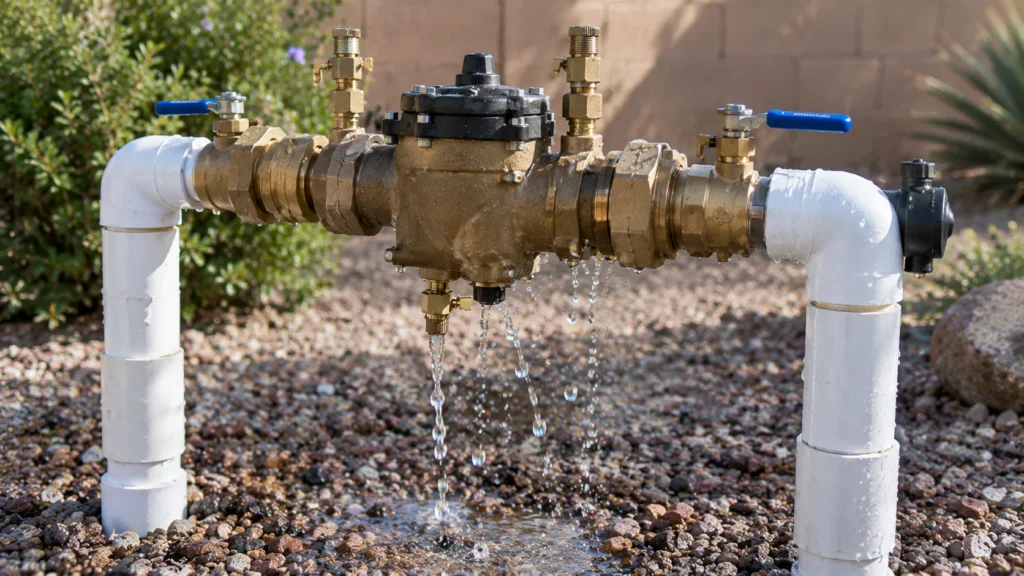
Water coming out of your backflow preventer usually means debris, a worn seal or check valve, a pressure change, a loose fitting, corrosion, or freeze damage. The exit point and duration tell you most: a brief relief-port discharge differs from a steady drip or a spray from a cracked body. Never plug or cap a relief opening.
Why Is Water Coming Out of Your Backflow Preventer?
Start with two observations: the exact exit point, and whether the flow stops on its own. Take a photo of the wet area and note the time of day before anyone touches the assembly – it makes the diagnosis faster and gives a tester something to compare against. A leak that appears only when the irrigation system starts points somewhere different from one that runs all day.
Which type you have changes where water can exit. A reduced pressure assembly has a relief valve that can discharge. A double check assembly has two check valves but no relief port, so water at the body or a fitting points to a leak rather than a relief discharge. A pressure vacuum breaker has an air inlet vent that can release water. If you’re not sure which you have, say so when you call.
Where Is the Water Coming From?
The relief valve or vent. On a reduced pressure assembly, the relief valve opens automatically when the pressure zone between the two check valves can’t be held, to protect your drinking water. Zurn Wilkins’ maintenance instructions for its Model 475 reduced pressure assembly note a brief relief discharge while the unit first pressurizes, and list a fouled #1 check, a fouled #2 check, and a fouled relief valve seat among the causes of ongoing discharge, alongside pressure fluctuation. A brief release that stops is different from continuous flow, which needs evaluation. Never cap, plug, or block a relief opening – it must be able to discharge freely.
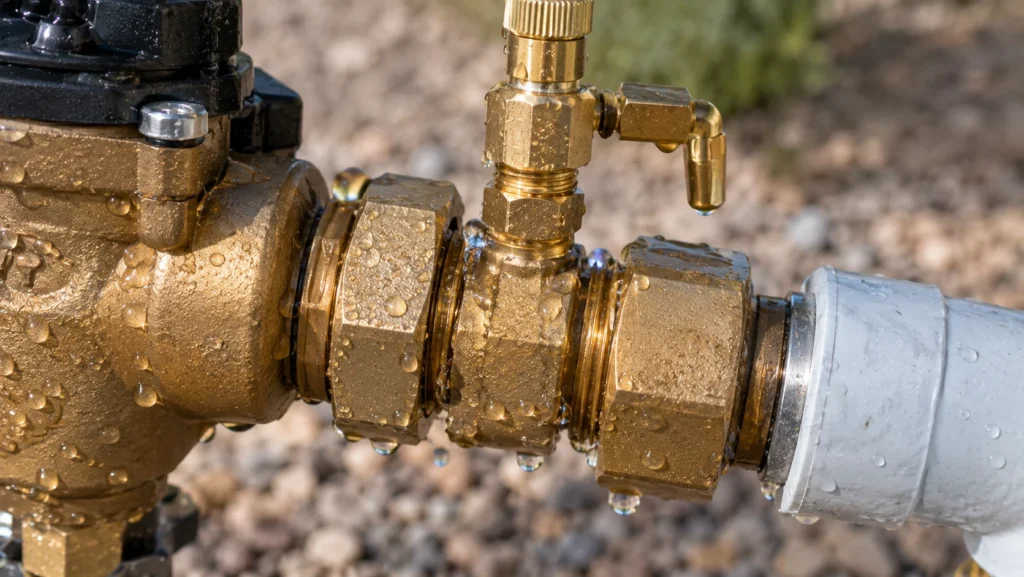
A test cock, shutoff valve, or fitting. Water at a test-port connection, valve, union, or threaded joint usually means an external leak, not an internal failure. Find the exact wet joint before assuming the whole assembly is bad; a single wet connection often points to a fitting, not the internals, and may be a much smaller repair.
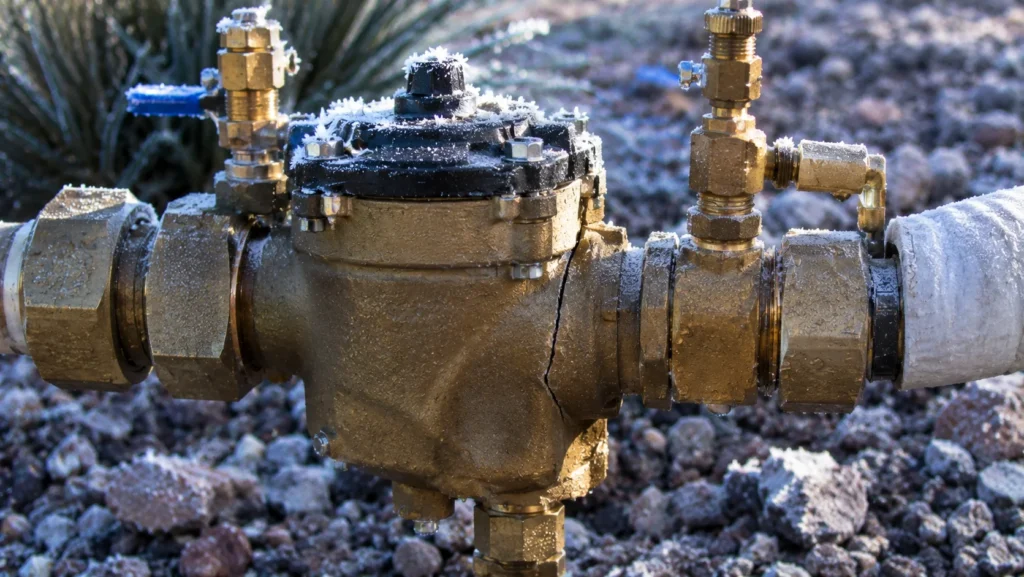
The body or a crack. Water coming directly out of the housing suggests a split, severe corrosion, impact damage, or freeze damage. Structural damage often means replacement rather than an internal repair, and active spraying needs prompt attention.
How can I tell if the leak is from the backflow preventer or nearby piping? Follow the water to its highest wet point and check the assembly, its fittings and valves, and the surrounding irrigation piping. If the source is still unclear, leak detection can trace it before anyone digs.
What Causes a Leaking Backflow Preventer?
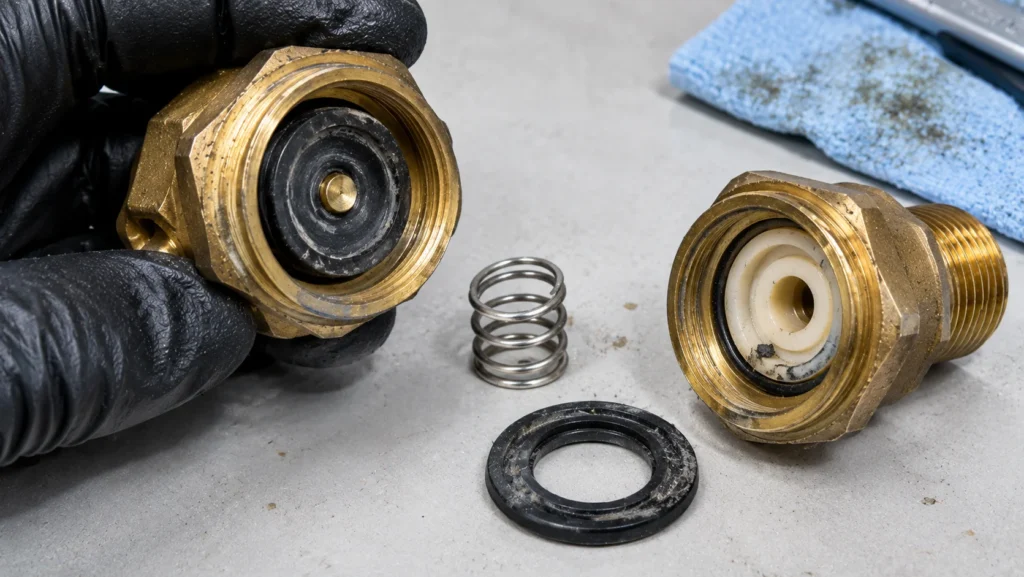
Debris, sand, rust, and mineral buildup. Particles can hold a check valve off its seat so it can’t close fully. Sprinkler or water-line work can introduce sand and sediment, and corroded piping can shed rust. Scale can also keep moving parts from seating properly. El Paso Water describes the local supply as moderately hard to hard, so mineral deposits are a realistic local factor – one factor, not the only one.
Can hard water affect a backflow preventer? Mineral deposits can build up on internal surfaces and interfere with movement or sealing. The effect depends on the assembly, the water, and how much has accumulated.
Worn seals, O-rings, springs, and check valves. Rubber and springs wear with age and repeated operation, so the assembly may stop holding a tight seal. An inspection is needed to identify which part failed.
Pressure problems. Supply-pressure swings, higher downstream pressure, water hammer, and thermal expansion can all push a reduced pressure assembly to discharge. Heated water in a closed section raises pressure; if that’s a suspect, have the water heater and its pressure relief checked as well.
Loose connections or installation problems. A fitting that isn’t sealing, or an assembly installed or reassembled incorrectly, can leak without any internal failure. Zurn Wilkins notes installation must be done by qualified, licensed personnel.
Corrosion and deterioration. Weather exposure and age weaken metal parts and connections, producing leaks different from a worn seal.
Does It Leak Only When the Irrigation System Runs?
Timing is a clue. Note whether water appears only when a zone starts, stops when the cycle ends, or continues afterward – and whether it began after seasonal start-up or sprinkler repairs.
Can a backflow preventer leak only at certain times of the day? Yes. Pressure and flow change during irrigation cycles, so a leak may only show then. Keep a note of when it happens.
Why does my backflow preventer leak after the sprinklers turn off? Discharge that continues after the cycle ends can mean the assembly isn’t returning to normal operating condition. How long it lasts is useful information for the inspection.
Can irrigation repairs cause a backflow preventer to start leaking? They can be the trigger or at least useful context. Sediment can be stirred up and parts disturbed, so mention any recent sprinkler, piping, or start-up work.
Can Freezing Cause a Leak in El Paso?
Yes. El Paso Water says it rarely freezes here, but above-ground assemblies are at risk when it does, and water that freezes inside can crack internal parts or the body. The leak may show up during the cold snap or after the thaw. El Paso Water’s guidance: if your backflow freezes or breaks, turn the water off at the meter. Repairs are the customer’s responsibility and a licensed plumber may be needed, per the utility’s backflow prevention page. A cracked assembly needs a different response from a worn internal part, so have it assessed before choosing repair or replacement; damaged supply lines around it may need pipe repair.
Is a Leaking Backflow Preventer an Emergency?
Not always. A short discharge that stops by itself may not need immediate service. Continuous flow, active spraying, pooling water, or visible cracks need prompt attention – and if water can’t be controlled, shut it off at the meter and treat it as an emergency plumbing situation.
Should I turn off my water if the backflow preventer is leaking? If it’s releasing a lot of water or you can’t control the flow, yes – shutting off the supply limits loss while the problem is assessed.
Can a small leak from a backflow preventer get worse? It can. A minor drip may stay minor, but changes in the pattern – more flow, a new leak point, longer discharge – are worth noting and acting on.
What Should You Do If Your Backflow Preventer Is Leaking?
- Confirm the source – make sure it’s the assembly, not nearby irrigation piping.
- Observe the pattern – brief, intermittent, or continuous.
- Check for damage – cracks, broken parts, severe corrosion.
- Keep relief openings clear – never cap or plug them.
- Don’t disassemble it without knowing the correct service procedure for that model.
- Arrange an evaluation if it continues, loses significant water, or shows damage.
Can a backflow preventer still work if it has a small leak? A visible leak alone doesn’t show whether the assembly is protecting your water. Testing under the required pressure conditions answers that.
How often should a backflow prevention assembly be tested in El Paso? El Paso Water says installed assemblies must be tested annually by a TCEQ-licensed tester, with the original report provided to the utility. For a residential sprinkler assembly, confirm what applies to you at 915-594-5782.
What should I tell a plumber about a leaking backflow preventer? Where the water appears, how often, whether irrigation is running, when it started, any visible damage, and any recent irrigation work.
Get the Source of the Leak Checked
A leaking backflow preventer doesn’t automatically mean the whole assembly needs replacing. Paso Plumbing (TX License #12051) can inspect the plumbing around your assembly, find where the water is escaping, and tell you whether it looks like a repair, a replacement, or a test-and-certify situation. Call (915) 200-8525 or request an estimate.
Sources: El Paso Water – Backflow Prevention and FAQ (epwater.org); Zurn Wilkins Model 475 reduced pressure assembly installation and maintenance instructions; Paso Plumbing company information as published on pasoplumbing.com.